Why the curve matters
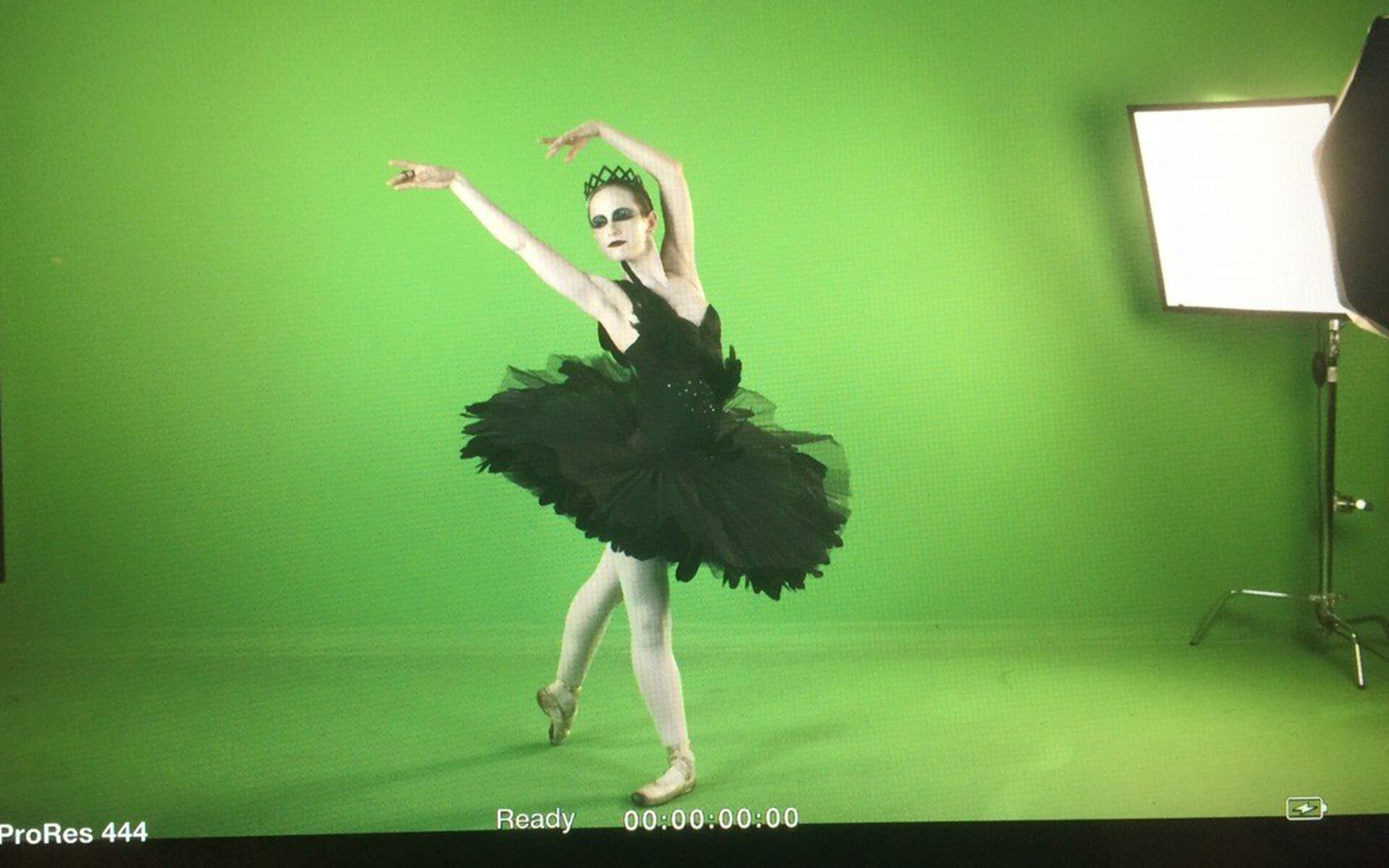
Anyone can hang a green cloth. What that gets you is a corner where the wall meets the floor, and a corner collects a hard shadow and a visible horizontal line. In the finished shot it reads as a person standing in a room, which is exactly what the green was supposed to hide - and every frame of it has to be repaired by hand.
A cyclorama curves continuously from the wall into the floor. There is no line and no corner, the light falls evenly, and the background reads as infinite. That is the difference between a key that works out of the camera and a key that becomes a post-production project.
The part that actually goes wrong
Chroma keying is simple in principle: the software deletes every pixel in a particular shade of green. That works for as long as the green is only behind the subject.
The problem is the light the green wall throws back. It lands on cheeks, on hair, on glasses, watches and bottles. The green behind a person can be deleted; the green on them cannot. This is why a serious green screen shoot spends much of its lighting budget on separating the subject from the wall rather than on the wall itself - distance from the background, backlight along the edges, and controlling how much the wall is lit in the first place.
It is also why a key shot in a room with a green cloth and a single lamp arrives in the edit as a week of rotoscoping, and a key shot properly arrives as a clip you can drop on a background.
Seeing the result on the day
The studio has a live key system: the background is composited in real time and shown on the monitor, so what you see while shooting is the finished frame rather than a green wall.
This is not a gimmick. It changes decisions you can only make while the talent is still standing there - whether the eyeline matches the thing they are supposedly looking at, whether the presenter is covering the chart, whether the product sits convincingly on the virtual table. And it lets a client in the waiting room, or on a video call from another country, approve the look on the day instead of two weeks later.
What people shoot here
Commercials & brand films
Backgrounds built in 3D, generated, or shot as plates - and changed after the fact without reshooting.
Video productionPresenters & training
A presentation keyed behind the speaker, a teleprompter in front, and a dozen lessons shot in a day.
How a studio day runsVideo podcasts
One room that can look like ten different sets, because the set is composited rather than built.
Podcast studioFootage that feeds AI
Avatars, character replacement and generated backgrounds all start with a clean key - which is why how it was shot decides the result.
AI video productionWhen green is wrong
AI video tools often work better on a neutral background - we paint the whole cyclorama white or grey.
White & grey studioBring the right wardrobe
The single cheapest thing you can do for a green screen shoot is check the clothes before the day.
- Nothing green, and nothing in a colour next to it - olive, teal, lime. It will disappear along with the background.
- No fine patterns. Thin stripes and small checks alias into moiré on camera, and the artefact survives the key.
- No shiny or satin fabric. It mirrors the green wall, and a reflected wall is just as hard to remove as a lit one.
- Matte, mid-tone colours key best - and they also look better on a background you have not chosen yet.
- Send a photo. Before the shoot, send us what the talent is planning to wear. Two minutes there saves hours in post.
What it costs
That is the room, the cyclorama, the lighting rig, the monitors, the sound system, the backgrounds, the waiting room and the makeup and hair stations. Cameras, an operator, a teleprompter and editing are separate - the full list is on the pricing page.
Questions
Can we bring our own crew and only use the studio?
Yes. Book studio time and arrive with your own people and equipment, or we supply any part of it. Both are priced separately.
Do you do the compositing afterwards?
Yes - keying, background work, graphics, colour and sound, including on footage shot elsewhere. See post-production.
How many people fit on the cyclorama?
8.5 by 5 metres is enough for a group shot, a two-hander with real separation from the wall, or a set piece the size of a small car - within the 90 cm door, which is the practical limit on what can come in.
Can the background be changed after the shoot?
That is the whole point of shooting on green. The same take can go on a different background a year later without anyone standing in front of a camera again.
Is there a background other than green?
Yes - white, black and grey backdrops plus ten other colours, and with notice we paint the whole cyclorama white or grey. See the white and grey studio.