The whole studio, not just the wall
When people compare studios they almost always compare one number: how many metres wide the background is. But a shoot day does not only happen in front of the wall. People arrive, change, get into makeup, wait their turn, and the client sits and watches. All of that has to happen somewhere.
A studio that is built properly gives each of those its own place: a waiting room people can actually sit in, an organised makeup and wardrobe area, and a monitor that shows whoever is outside what is happening inside. That is what makes a day flow - the person waiting prepares quietly, the client watches closely without walking into frame, and the crew works without planning around logistics.
- The green area is 43 m² and the studio as a whole is 58 m², so the crew has somewhere to work too. The waiting room is 42 m² and holds up to 20 people, with a makeup station and a hair station beside it. All the measurements are on the specs page.
Good lighting saves hours in post
It is easy to think of lighting as something that only affects how the shot looks. On green screen it decides directly how long the edit takes. The more accurate the lighting, the cleaner the background and the less green spill on the subject - and the faster and easier everything afterwards becomes.
And you need both: a light for the background and a light for the subject. They do different jobs, and anyone trying to cover both with the same lamps pays for it at the edit stage.
That is especially true for projects that involve AI. The closer the incoming material is to the intended result, the easier the effects work - and if you are working with tools priced in credits, it saves money directly.
- Two separate lighting systems, one for the background and one for the subject, enough for large groups, plus RGB panels for colour and a grip kit. We like lamps; it has been a pleasure watching them get smaller and more precise over the years.
How the footage gets edited
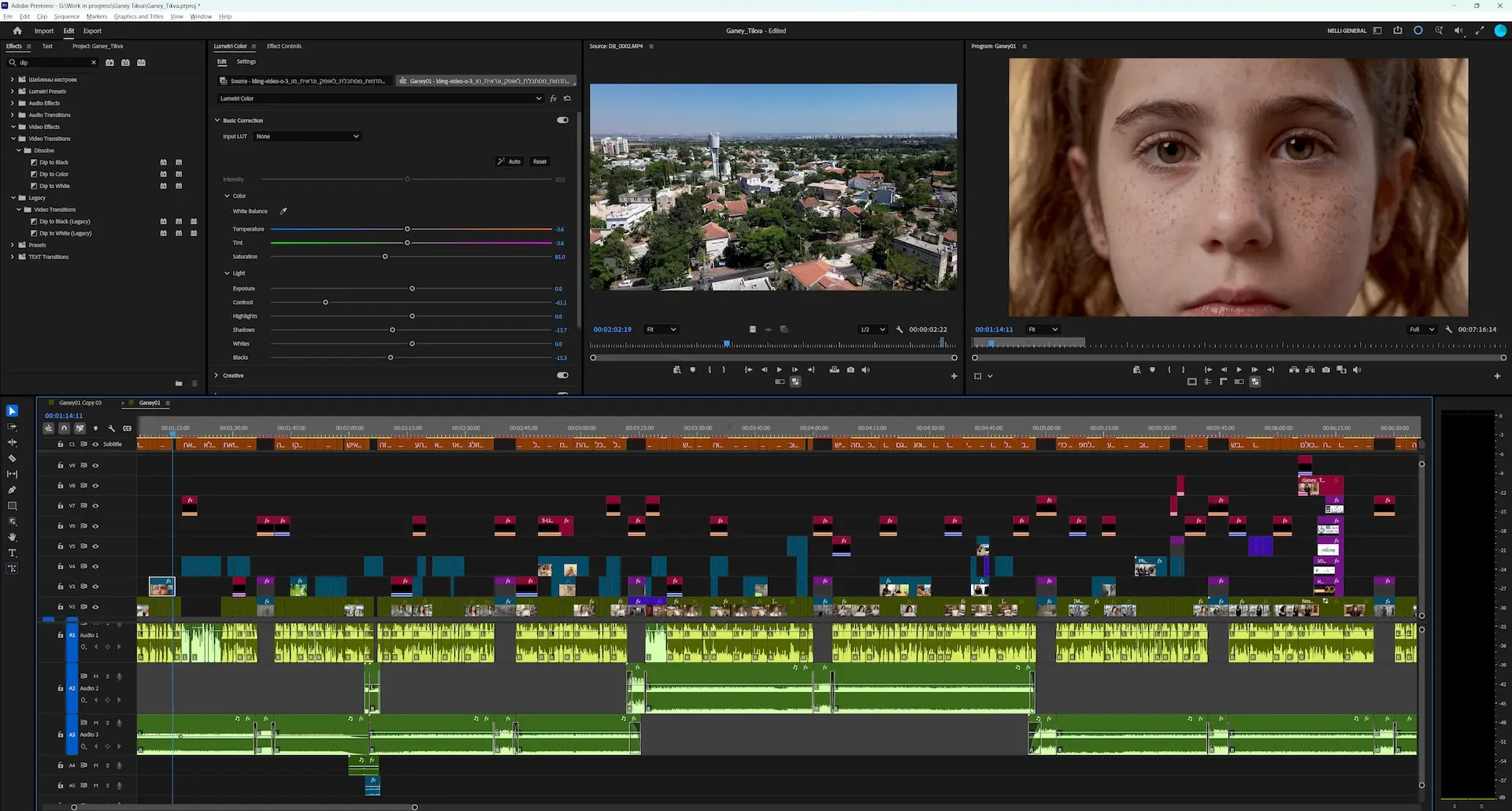
Editing green screen is easier now than it has ever been. Standard editing software keys a green background without special plugins, and AI tools have taken over much of what used to be long manual work.
The process itself has not changed, and it happens in stages. First offline - choosing takes and building the structure, without touching the look yet. Once the cut is approved come the key and the effects - the background is replaced, elements are finished and graphics go in. Finally online: colour, sound and export.
At the end you get a full-quality master, and beside it the versions each destination needs - 16:9 for a site and YouTube, 1:1 and 9:16 for social, and a broadcast standard when it is required.
- We are a post house as well as a studio, and AI is part of daily work on every project - rotoscoping and separation, audio clean-up, subtitles, and generating shots and backgrounds that were never filmed. You can also shoot and edit in the same place, with nothing shipped between vendors. Details on the post-production page.
Space only, or full production
Three models, and all of them work. The difference is how much of the craft you bring with you. Plenty of productions arrive with a full crew and use the space alone, and plenty of businesses want someone to handle everything. There is no right answer here.
| Model | Who it suits | What is included | What to confirm |
|---|---|---|---|
| Space only | Production crews, photographers and creators with their own kit | The studio, the backgrounds and the background lighting | That your operator has worked on green before |
| Full service | Businesses, lecturers and content creators | Operator, camera, lighting, sound, teleprompter | Exactly what the package covers |
| End to end | Anyone who wants a finished film | All of it, plus directing and editing | The schedule and how many rounds of notes |
The simple question that settles it: do you have a camera operator who has already worked on green screen? If yes, space only gives you exactly what you need at the right price. If not, a crewed package saves you the learning curve - green screen lighting works differently, and someone has already done it thousands of times.
It is also worth asking whether the studio closes the whole loop. Here you can walk in in the morning and leave in the evening with a finished film - shoot and edit in the same place, with no coordination between vendors and no raw footage travelling back and forth.
In the end, someone takes responsibility
Neither the wall nor the lamps are responsible for what comes out of a shoot day. The people in the studio are the ones who take responsibility for the quality of the material. They are the ones who will notice in real time that the lighting is not clean, that the sound picked up a noise, that the take did not actually work. So the real question is not what equipment is standing there, but who you are trusting.
One way to test that is to ask whether the studio is the main business or a side activity. In places where the space is an add-on to something else, your shoot day gets the attention that is left over. Where it is the business itself, the person receiving you does this every day and knows the problems before they happen.
Green screen is a separate skill. An experienced crew knows how to light a room beautifully, but lighting for a key is a different job - and the gap between the two only shows up in the edit, when it is too late to fix.
- The studio and the production company are the business itself, not an addition to another one - since 2010, in the same place. About us.
Eight questions worth asking
- Who will be in the studio on the day? Someone who knows the project in advance arrives prepared, and you feel it all day.
- Do you cover everything, from the shoot to the finished film? A studio that films and edits saves coordination between vendors and the shipping of footage.
- Is there separate lighting for the background? Without it the background is not even and the key breaks at the edges.
- Where do the people who are not filming sit? Participants waiting, a client watching, makeup and wardrobe - all of them need somewhere out of frame.
- How wide is the door? A boring question that ruins shoot days. If a set, a sofa or large equipment has to come in, measure first. Ours is 90 cm.
- What format do we receive the material in? A full master and the per-platform versions - worth knowing in advance.
- Is there acoustic insulation? A studio next to a busy road will have you re-recording everything.
- What happens if we run over by an hour? Better to know the number before the day than at the end of it. Ours is written on the rate card.
What it costs
Our rate card is published in full on the pricing page - an hour, a half day and a full day, and exactly what is included at each level. It covers most of what a production needs. When something unusual is required (a built set, wardrobe, hair, or rigging from the ceiling hooks) that is quoted separately and the proposal is built around what the production actually demands.
Questions
What size studio do I need?
It depends what you are filming. For an interview or head-and-shoulders almost any studio will do. For full body, movement or several people in frame you need a bigger space. And remember the question is not only about the shooting area - a waiting room and a makeup station are part of the answer to whether the day runs.
Why is there a green fringe on the hair?
Spill: light hitting the green background bounces back and colours whatever is close to it, especially light hair and light clothing. The fix is lighting - background and subject lit separately, with a soft backlight behind the subject creating the line that separates them. In the edit you can reduce it, not erase it.
What format do we get at the end?
A full-quality master, plus the versions each platform needs - 16:9 for a site and YouTube, 1:1 and 9:16 for social. If it is going to air, a broadcast standard as well.
Can I bring my own camera operator?
In most studios yes, and it is called booking the space only. Check that they have worked on green before - green screen lighting is not portrait lighting, and an excellent operator who has not done it can hand you material that is hard to cut.
What does an hour of green screen studio cost in Tel Aviv?
Our full rate card is open on the pricing page - an hour, a half day and a full day, and what is included in each. Beyond that every production is quoted for its own size and needs, so it is worth sending the details and getting an exact number.